
Overall, Australian Labradoodles are extremely clever, sociable, comical and joyful. They are energetic when free and and quiet when handled, and are keen and easy to train. They should approach people in a happy, friendly manner. Australian Labradoodles display an intuition about the emotional state of family members and their needs. This ability to “know” is what has made the Australian Labradoodle an excellent dog for individuals with special needs.
This breed is athletic and graceful with a compact, medium-boned body. Their coat is non-shedding and easy to manage.
SIZE
At this stage in the breed’s development, the Australian Labradoodle comes in three sizes:
- Miniature: Between 14-16 inches (35-42 centimetres) in height at wither, but not more than 17 inches.
- Medium: Between 17-20 inches (43-52 centimetres) in height at wither, but not more than 21. Ideal size for a female is 17-19 inches; for a male, 18-20 inches.
- Standard: Between 21-24 inches (53-63 centimetres) in height at wither, but not more than 25 inches
Prairie Doodles breeds all three sizes of the Australian Labradoodle.
COAT
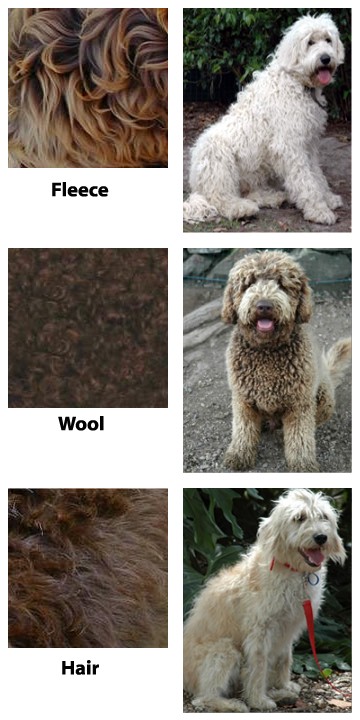
- Coat length should be 4-6 inches long.
- It should be straight, wavy or forming spirals and should naturally grow in staples with a soft texture.
- It should not be too thick or dense nor should it be fluffy or fuzzy. It should be a single coat; any sign of a double coat is a fault.
- The ideal fleece and wool coats can be spun successfully. Hair coat (hair texture that sheds) is undesirable and is a major fault.
- It is important that the coat gives the impression of being a fleece in type rather than dog hair.
- It is acceptable to see a coat change from the puppy to adult coat, and also during hormonal changes in fertile bitches.
Fleece
The fleece textured coat is a soft texture as in the Angora goat. It can either have a straight wavy look or a soft spiraling curl look. It is an easy-to-manage textured coat. All Prairie Doodles are fleece or curly-fleeced coated.
Wool
The wool coat is like a lamb’s wool in texture. It should have the appearance of looser spiraling wool, which opens up easily to the skin. It should not appear thick and dense or tightly curled.
Hair
The hair coat has odor and sheds in varying degrees. (Usually seen in the early generation dogs)
COLOURS
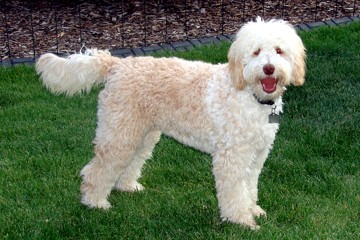
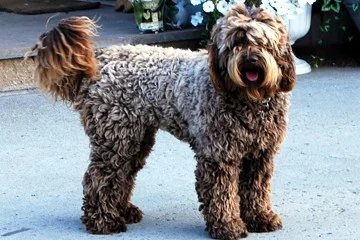
The Australian Labradoodle comes in a variety of colours, which are outlined in detail here. Prairie Doodles produces mostly cream, apricot, red, black, chocolate, parti and abstract colours. We occasionally have litters with rarer patterned colours.
Australian Labradoodle size, coats, colours source: Australian Labradoodle Association
Australian Labradoodle history

The First Labradoodle
In the 1980’s Wally Conran the breeding manager of the of the Australian Guide Dogs Assoc in Victoria, first purposely mated a Poodle and a Labrador Retriever to produce a hypo-allergenic guide dog, for a visually impaired woman in Hawaii. Of the three resulting offspring, only one puppy, Sultan proved to be suitable. Sultan’s allergy-friendly coat, trainability and temperament produced the first officially purpose bred Labradoodle.
Multi-generation
Tegan Park and Rutland Manor introduced other breed infusions into Labradoodles and went on to further develop, promote and market the non-shedding Multi-Generation Labradoodle, selling many breeding labradoodles worldwide. Kate Schoeffel a veterinarian of Condobolin, NSW; was the first to introduce and breed miniature labradoodles in 1994.
Worldwide popularity
Labradoodles reached great popularity worldwide, especially with the advent of the internet. Recommended Breeder websites were set up to provide information and encourage health testing and provide a forum for discussion and sharing of knowledge; with the earliest being Blue Sterlings Goldendoodle site. This public breed community has developed into one of the largest in the dog breeding world and has come to the aid of many a breeder, family or pet in need.
The first Labradoodle associations
Breed Associations were set-up; first in Australia and then in the United States; to uphold ethics, monitor the development of the breed and maintain a pedigree database registry. Two of these Associations (ALA and ALAA) joined forces to create a shared vision and work cooperatively on an International Association (IALA) Breed Standard, Grading Scheme and the sharing of Registry pedigree information.
Compulsory health testing
The Breed Associations introduced a new of level compulsory health testing (hips, elbows, PRA eye, DNA parentage verification) requirements, previously unheard of in the pure-bred dog world. The Internet created access to a new level of information, which has led to more knowledgeable pet buyers. Testing was expensive and further increased the price of Labradoodles, but the newly educated public, via the internet, embraced, expected and encouraged this new level of responsible breeding via health testing. Breeders provided Written Health Guarantees and Lifetime Re-homing for their Labradoodles.
The perfect Labradoodle

The recipe for the perfect Labradoodle is still being developed and monitored adapted by these associations. Labradoodles are becoming very consistent in type and now breeding true, but of course new lines are still needed to ensure the genetic diversity of the Australian Labradoodle. It will only be a few short years before the required criteria is met; to become a recognized breed with the International Kennel Clubs.
For a new breed to become recognized it must be more than the combination of two breeds. Labradoodles in the past are known to have in addition to Poodle and Labrador Retriever; American/English Cocker Spaniel, Golden Retriever, Curly Coated Retriever and Irish Water Spaniel.
It appears that the Curly Coated Retriever and Irish Water Spaniel were very minor contributors to the breed and will probably never be used further. Though the name Labradoodle is a bit of a misnomer, it is the name that everyone knows and recognizes and to change names now would only create confusion.
Breed history source: Cloud Catcher Labradoodles